
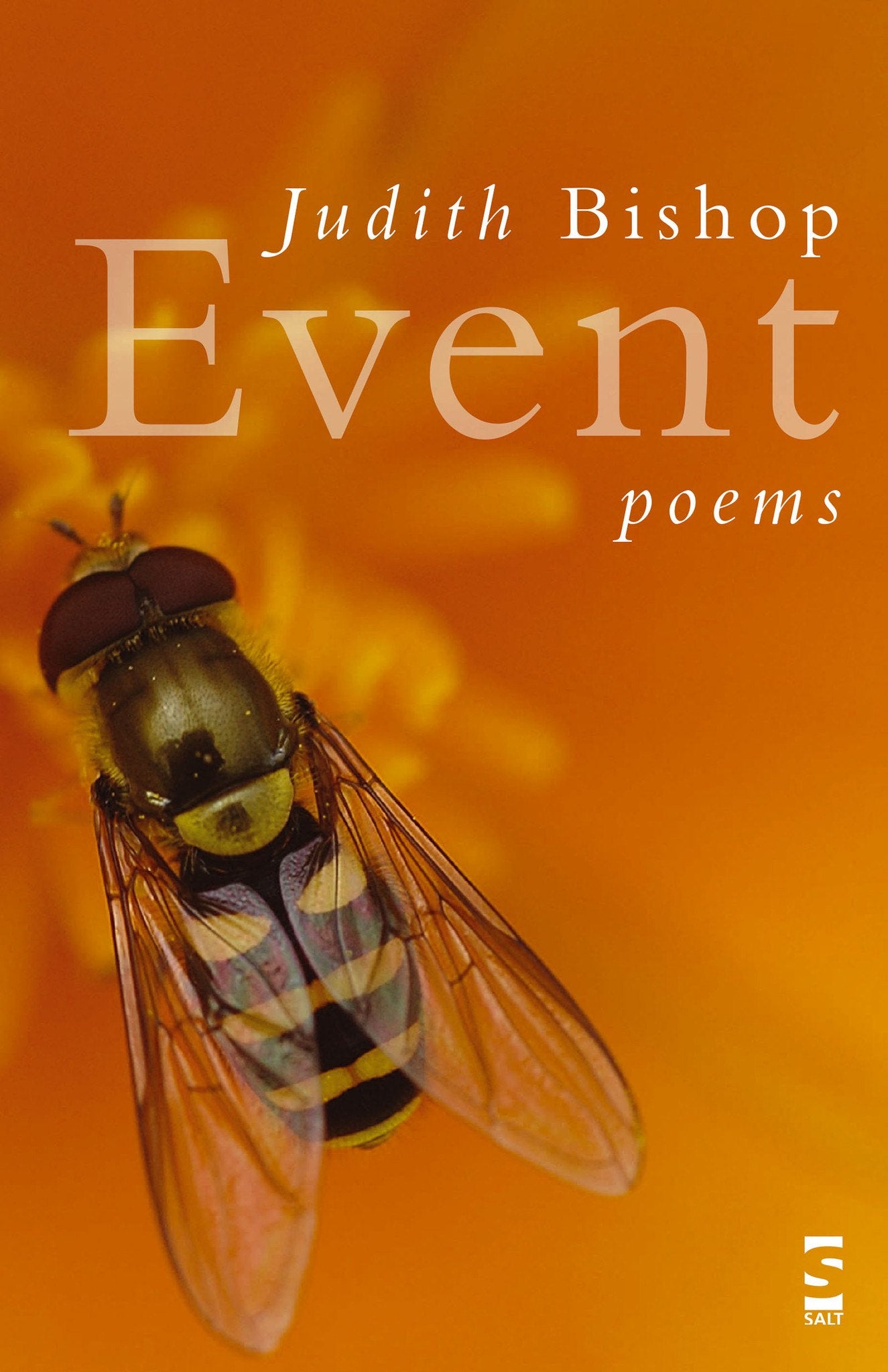
Judith Bishop
Event
Event
ISBN:9781844712830
Couldn't load pickup availability
Also available from

And all UK and Irish bookshops
Synopsis
Event, the first book by Australian poet Judith Bishop, is the work of a border-crosser. Emotionally intense, formally inventive and musical, with influences ranging from Ted Hughes and Elizabeth Bishop to Yves Bonnefoy, these poems have won prestigious awards in Australia and the U.S. and feature in The Best Australian Poetry 2006 (U.Q.P) and The Best Australian Poems 2006 (Black Inc.).. Local and global at once, with a strong naturalist bent, they gather in birds, flora and fauna from across four continents, Australia, North and South America and Europe. Central to the collection is a striking sequence poem which inhabits the voice of the Aztec translator in the Spanish Conquest, La Malinche. Indeed, the human voice – a form of breath, but “irreversible” in what it says and does – performs the principal role in this book’s erotic theatre of love and betrayal. Event is, above all, a book of intimate dialogues between a human self and her others: lovers, animals, elements of the natural world, and deities, some distant, some destroyed. Wind, too, has a leading part, taking on the dual role of a natural force and of something close to fate. Rising as if out of nowhere in these poems, wind is a metaphor for the pure nature of events which occur without premonition and without recourse.
Praise for this Book
‘Here is a remarkable poet, in whom delicacy of language equals fineness of perception. She sings “as if”, as though all barriers had vanished between self and the shimmering world. Lightness and modern pastoral pervade her cities, animated by birds, creatures of the spirit.’ —Chris Wallace-Crabbe
‘Judith Bishop is a poet of unusual delicacy, yet she can phrase aphoristic, even proverbial, knowledge with complete authority. Accordingly, she writes ‘if the gods weaken, we’ll be left alone on earth’ and ‘Don’t cough,…: only listen. This is how the gods speak.’ She is entitled to speak both for the gods and about them: her mind is extraordinarily refined. The coarsenesses of the world are confronted by clear-eyed analysis. Cortés’s conquest of Mexico, as seen by his Aztec amanuensis, Doña Marina, shares lyric presence with a strangely quiet pantheism elsewhere in the collection. Throughout, a wholly original voice makes itself heard.’ —Peter Porter
‘‘We attend frail breakings. Hymn/to insufficiency,’ says Judith Bishop in her dazzling debut, Event, a book that argues for an almost prayer-like attention to the details of a world that seems both our own and newly – thrillingly – strange: ‘error orbits error,’ the sacred routinely turns to ash, we betray ourselves and others equally. Against this backdrop, Bishop speaks to and for the human impulse to strive anyway, to ‘[search] for tenderness,’ for transformation if not transcendence – and yes, for joy: ‘joy, which meant a life, which meant/its ending, soon or later; which emboldened both of us —’ These are splendid poems indeed, whose intelligence, vision, and sheer beauty at every turn persuade.’ —Carl Phillips
Product Details
| Extent | 84pp |
| Format | Paperback |
| Publication Date | 01-Jun-07 |
| Publication Status | Active |
| Series | Salt Modern Poets |
| Trim Size | 216 x 140mm |
| Subject | Poetry by individual poets |
